
Butterfly Photography - Part B
Photographing insects and butterflies
Beyond the camera equipment and the flash, there are four important components that build a good picture, especially in insect and butterfly photography.
Sharpness:
Sharpness (focus) of the image is one of the important components in photography. In macro photography, the focus subject is especially sensitive because the depth of field is low (which makes it difficult to obtain a sharp image). It is not always possible to get the desired focus in automatic shooting, because in many cases we want to choose a different focus point than the one chosen by the camera, and experienced photographers do indeed shoot in manual focus (MF). Below are suggestions for improving image sharpness.
- It is important that the insect's eyes be in focus.
- There are cameras on which it is possible to shoot in Focus Bracketing. In this mode the camera takes several pictures at different focus distances and the photographer must choose the picture with the desired focus.
- In some cameras it is possible to set the focus point on any point on the screen. This is an advantage when photographing the insect when it is at the side of the image and not in the center (see composition section).
- You should make sure to shoot immediately when the object comes into focus. Any delay, even the slightest, can lead to movement of the insect/butterfly and unsuccessful focus.
- The movement of the photographer's hand during shooting greatly affects macro photography, and therefore the shot should be taken as quickly as possible (preferably above 1/80 second and even more, depending on focal length, the presence of image stabilization, use of a tripod, and more).
- When the insect/butterfly occupies most of the image, the focus can be set as multi-point focus. The camera processor calculates the focus point as the average of the points that were examined. It is important to remember that in macro photography the depth of field will be shallow and one must "fight" for every particle of sharpness.
It is worth buying an SLR camera on which it is also possible to shoot through the LCD (Live View) in a mode where the true image sharpness can be seen.
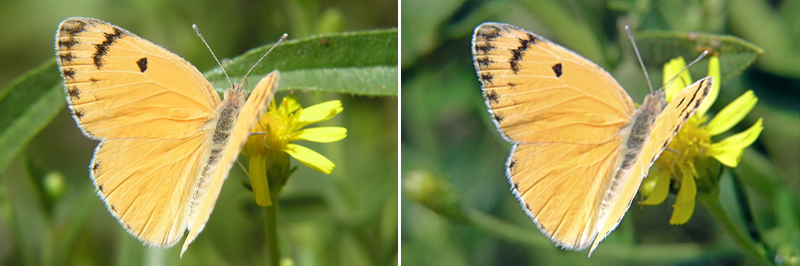
Mallow skipper Colotis fausta
photographed at 180 mm zoom and with a 4+ close-up macro lens.
The right image is sharp and clear thanks to the "focused eyes".
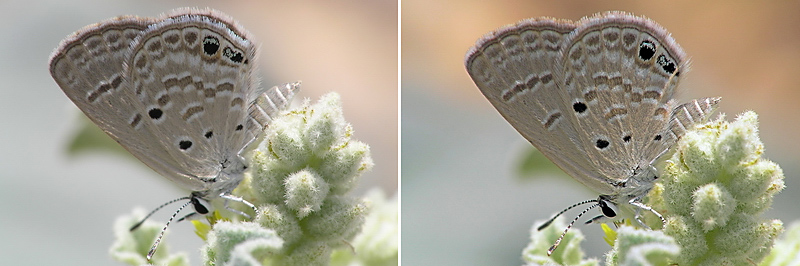
Chilades galba Chilades galba
photographed at 380 mm zoom and with a 5+ close-up macro lens.
The right image is sharp and clear thanks to the "focused eyes".
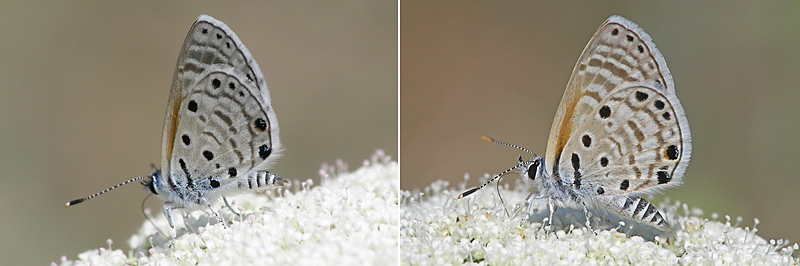
Azanus jesous Azanus jesous
photographed at 280 mm zoom and with a 5+ close-up macro lens.
The right image is sharp and clear thanks to the "focused eyes".
Background
In order for us to distinguish the butterfly well, it is desirable that it be separated from the background (both in color and in sharpness). When the background is clear, it draws much of the viewer's attention and the subject loses its distinctiveness. Only when the butterfly stands out and differs from the background can we see it clearly. Of course, if the goal is to show the butterfly when it is camouflaged on a plant, trunk, or stone, it is worth emphasizing the background as well.
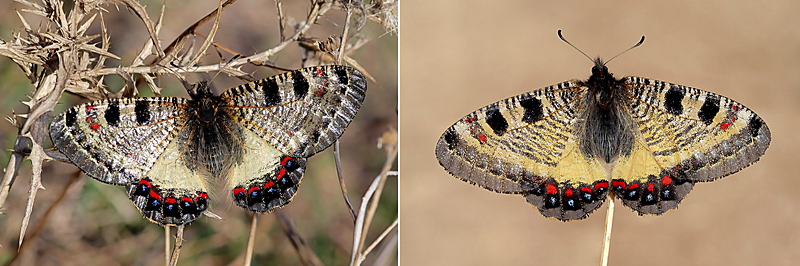
photographed with a 50 mm macro lens (right) and a 105 mm macro lens (left)
The right image is clearer thanks to the distinct background that highlights the butterfly.
When we photograph butterflies in flight, it is difficult to dictate to the butterfly where to land. One way to separate the butterfly from the background is to blur the background by reducing the depth of field. Shooting with a wide aperture creates a shallow depth of field and in this way it is possible to create a good separation between the background and the photographed butterfly. Of course, not at the expense of the butterfly's sharpness. Adult butterflies standing with wings spread or closed are flat. In addition, they usually stand on a flower or a tall plant that separates them from the background. Therefore, even shooting with a wide aperture "does the job" and it is easy to separate them from the background. In photographing a butterfly with half-open wings or caterpillars (which are "three-dimensional"), the situation is more difficult, but with experience it is usually possible to create the desired separation.
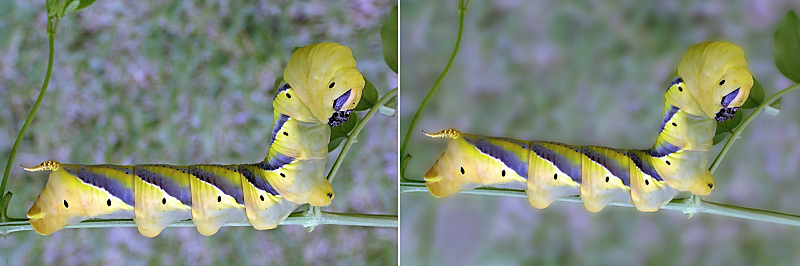
photographed at 120 mm zoom and with a 4+ close-up macro lens.
The right image is clearer thanks to a blurred background caused by shooting at a low f-number, which results in a shallow depth of field.
Focal length
Shooting at a longer focal length allows shooting from a greater distance. The advantages and disadvantages of a long focal-length lens are discussed in the chapter on lenses. Beyond the advantage that the butterfly will not fly away, there is another advantage: the background coverage area is smaller and therefore the background is more uniform.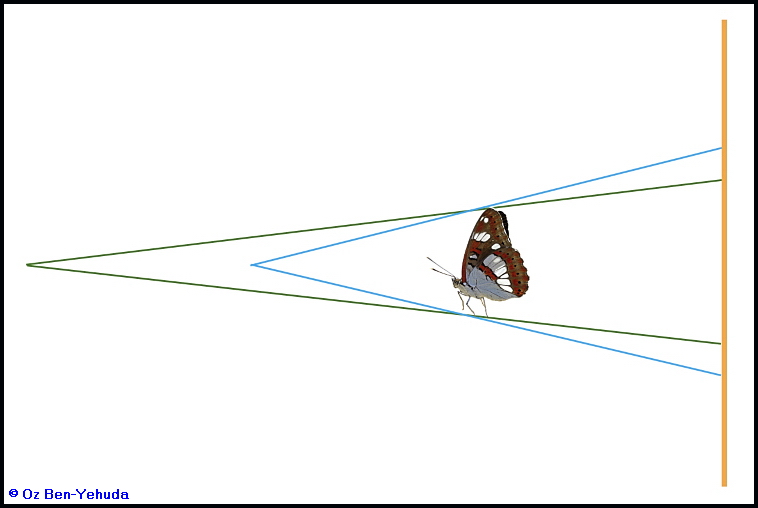
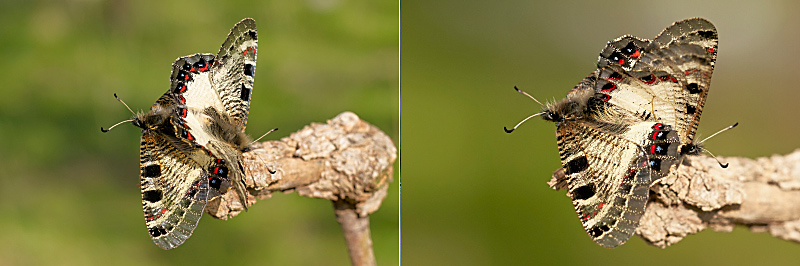
photographed with a 150 mm macro lens (right, crop factor = 1.5 ) and with a 70 mm macro lens (left, crop factor = 2 )
The right image has a more uniform background thanks to the focal length
Composition
Composition determines the best angle for photographing the insect/butterfly. For insects, it is advisable to photograph the insect from the side at an angle of about 45 degrees, focusing on its front part. For butterflies, when the wings are open, the butterfly should be photographed from above, and when its wings are closed, it should be photographed from the side with the camera perpendicular to the butterfly at its middle or front part. Do not photograph the insect/butterfly from behind or from below, since its front parts and especially the eyes are the most important in photography. When its wings are half open, it should be photographed from the angle where the visible wing surface will be maximum.
Of course, in many cases the butterfly does not stay at our request and is not in the desired angle.
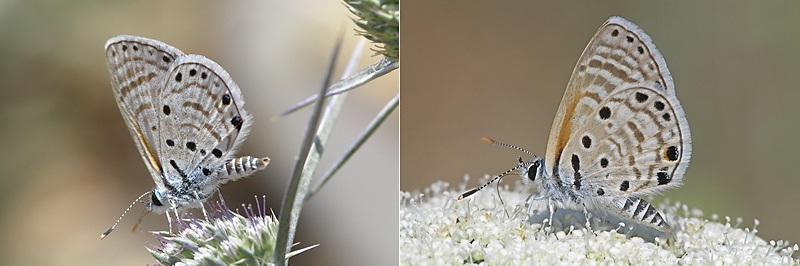
photographed at 280 mm zoom and with a 5+ close-up macro lens.
The right image was photographed with the correct composition, perpendicular to the butterfly. The left image was photographed from a rear angle and from a view from below and therefore is not as successful as the right image
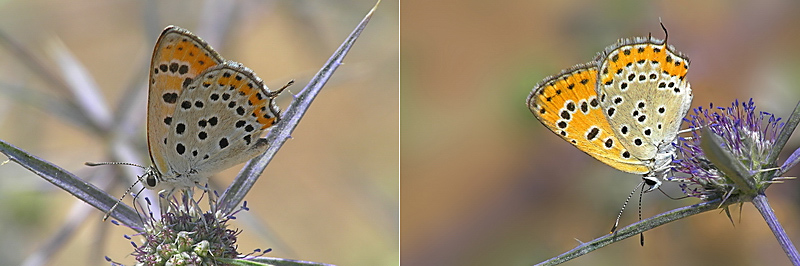
photographed at 220 mm zoom and with a 5+ close-up macro lens.
The right image was photographed with the correct composition, perpendicular to the butterfly. The left image was photographed from above and therefore is not as successful as the right image. The background too (previous section) interferes in the left image.
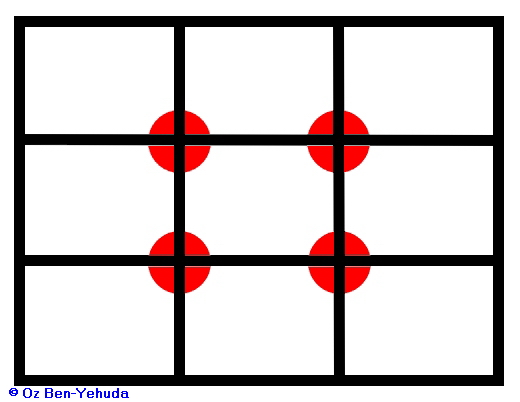
Beyond the shooting angle, it is preferable to photograph the insect using the Rule of Thirds. In this method, the image is divided into three equal parts on the horizontal side and three equal parts on the vertical side. The center of the subject should be placed at one of the 4 intersection points of the lines (marked in red), not in the center of the image. In this way the butterfly will indeed take up a smaller part of the image, but the composition will be more successful.
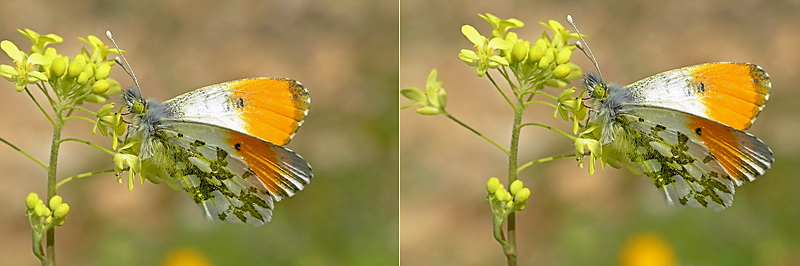
Photographed with a 200 mm zoom and a 5+ close-up macro lens.
The right image is more interesting because of the butterfly's position, which is not in the center of the image.
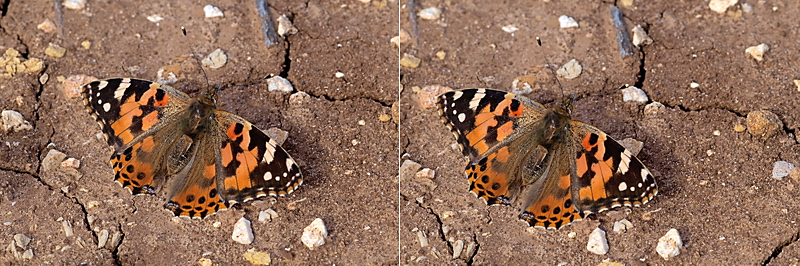
Photographed with a 105 mm macro lens
The right image is more interesting because of the butterfly's position, which is not in the center of the image.
Depth of field (DOF)
To increase the depth of field, shoot with the aperture as closed as possible (high f-number). As mentioned (in the background section), when photographing flat insects (such as adult butterflies), it is advisable to use a relatively shallow depth of field, in order to get the butterfly in focus and the background blurred, which highlights the butterfly in the image. Choosing the right aperture setting to achieve the desired depth of field is a matter of experience, and one should not be discouraged at first when the photos turn out less successfully.
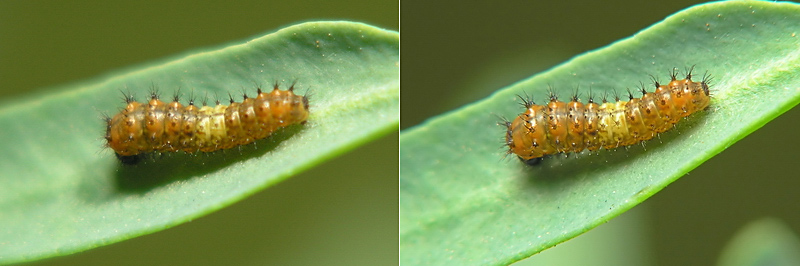
Common Swallowtail – caterpillar Papilio machaon
A crop of a photo taken with a 380 mm zoom and a 7+ close-up macro lens, with regular flash lighting and a diffuser.
The right image was taken with a smaller aperture (f/8 compared with f/4), which allows greater depth of field and therefore the image is clearer
When photographing butterflies or "three-dimensional" insects, in which depth of field is very important, the focus is not supposed to be locked on the nearest area of the butterfly/insect but on the first third of the subject. In such a case, the depth of field will extend in both directions to the maximum extent.
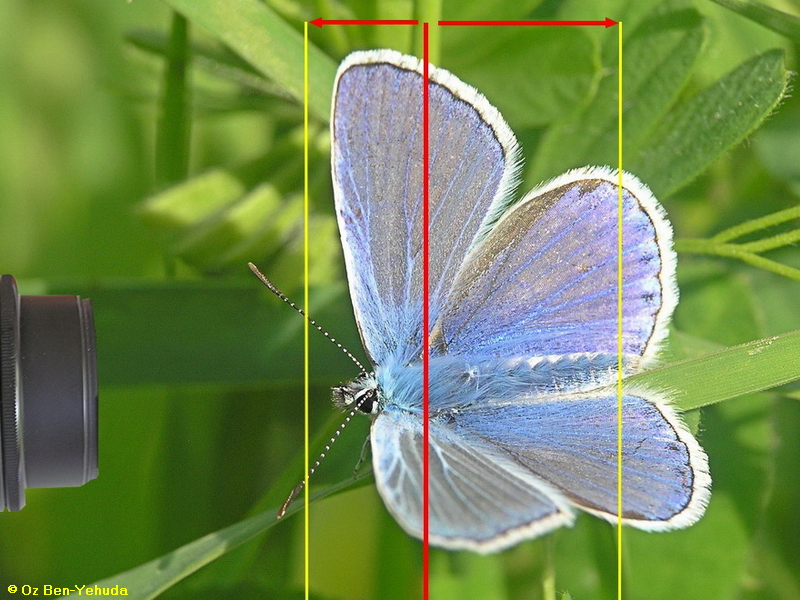
Common Blue - male Polyommatus icarus
Photographed with a 180 mm zoom and a 5+ close-up macro lens.
In front-view photography, the image should be focused on the red stripe area. In this case, the sharpness will extend, more or less, between the two yellow stripes (depending on the aperture setting) and will be at its maximum.
Important note to conclude
Despite all of the above, cameras today are very sophisticated, and if we photograph with the right equipment in automatic mode, we will get beautiful, sharp images. Therefore, as a final recommendation for beginning photographers: Don't be shy, start by shooting in automatic mode and, over time, start changing different shooting modes, gain experience, and improve the quality of the images.