

The Concrete Stream (Naḥal Ra'ah) – environmental horror
The "restoration" project of Naḥal Ra'ah is probably one of the most serious environmental crimes we have been privileged to witness in recent years: a section of the stream channel, kilometers long, was covered with concrete.
Attached is the letter of Prof. Avital Gazith (Avital Gasith), dated 23.12.13, regarding the scandalous project.
For quick skipping:
Response of the Head of the Water and Streams Division at the Ministry of Environmental Protection
The Concrete Stream (Naḥal Ra'ah) – an environmental horror made in Israel 2013
Hello,
I became acquainted with the scandalous project in Naḥal Ra'ah, the Rosh HaAyin section, when a concerned citizen and a conscientious professional drew my attention to unusual activity (to put it mildly) in Naḥal Ra'ah. The pictures shown to me sent me to the site, and after seeing with my own eyes, I can only testify that the environmental damage exceeds all imagination. I am still agitated, so I apologize in advance; unlike my habit, my language this time will not be diplomatic, and I will say things as they are, plainly and without embellishment.
I can describe the act only as an environmental crime that has no equal in the streams of Israel. The act takes us decades backward in everything related to stream restoration. Even in the 1960s, 1970s, and 1980s, when concrete was not spared in drainage contexts, they never reached the scale visible in Naḥal Ra'ah. In Eastern European countries where environmental sins are known to all and similar acts were carried out decades ago, efforts are being made today to remove the shameful evidence and restore the former glory (for example in Leipzig, formerly East Germany).
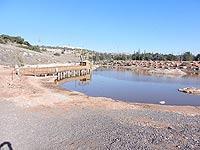
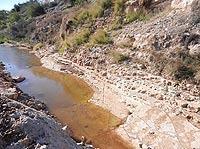
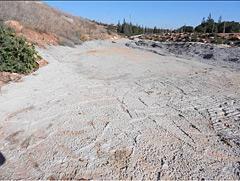
In the case at hand, this is a project within the framework of the Rosh HaAyin promenade, לאורך a stretch of several kilometers alongside the Naḥal Ra'ah channel. I have nothing against the promenade itself; it seems to meet the needs in a reasonable and attractive way. But במסגרת the project of creating an "ecological park," a stretch of several kilometers of the channel was covered with concrete across its entire width, and along its entire length a chain of concrete pools was laid out that are nothing but a scenic "circus" and an environmental nuisance whose damage does not require an expert to understand. I attach below several photos of this masterpiece, judge for yourselves.
I wonder before you: where have all the insights gone that we painstakingly learned, internalized, and accumulated over the past 15–20 years about stream restoration? One of the cornerstones of these insights is that concrete and a stream do not go together (with the exception of a few cases of drainage constraints specific in which solutions in natural stone, including boulders, are not sufficient). Here we are talking about burying a stream channel for kilometers in concrete while creating a "circus" of pools and waterfalls. Did the fact that this is an intermittent stream "confuse" the planners, who thought this was not a stream and treated the channel as a ditch in their private yard? It is more likely that it exposes the ignorance of all those involved, who did not know at all what the importance and unique quality of intermittent streams are. It seems to me I would not be mistaken in assuming that at least some of the planners do not have relevant training in stream restoration and certainly have never participated in a stream restoration conference. I wonder where the Ministry of Environmental Protection was? Where was the Nature and Parks Authority? Where was the drainage authority (which together with ecologists we held an eco-hydrology conference about three years ago, at which it was once again made clear that there is no place for concrete in streams)? Did the project undergo professional review? Who the hell approved this terrible project? The Ministry of Environmental Protection held a study day on stream restoration about a week ago, and no one bothered to present, even in a single word, the environmental horror that has been taking place for many months.
Here I stop my claims as an expert in stream restoration and cry out as a citizen of this country! If the experts are right in their cry (I cannot imagine that there is a stream-restoration professional who sees the situation of covering an intermittent stream with concrete as a legitimate project), then there is no escaping the following conclusions: a. Demand from those responsible for the project planners and executors to disqualify all those involved from any possibility of being involved in future stream-restoration projects in Israel (otherwise there is a danger that the environmental harm will spread to other streams; to my understanding, in Naḥal Modi'in and Naḥal Yavne, for example, there are already intentions to create pools, waterfalls, and swirling water within the channel). b. In addition, the distortion must be corrected, כלומר removing the concrete from Naḥal Ra'ah; otherwise the colossal environmental damage will remain forever a disgrace. c. As a citizen I add and cry out,
Who approved burying hundreds of thousands of shekels in this environmental crime?
I will recommend that every citizen visit the site and see for themselves the "act of creation." One does not need to be an expert to understand that something here is "not right." To the Society for the Protection of Nature, I suggest organizing tours to Naḥal Ra'ah and exposing to the public the magnitude of the environmental horror. Perhaps the environmental shock will give rise to a cry to the decision-makers: Draw lessons, assign responsibility, correct the distortion, and prevent similar action in the future!
With greetings and much sadness over years of work that were as though they had never been!
Avital Gasith
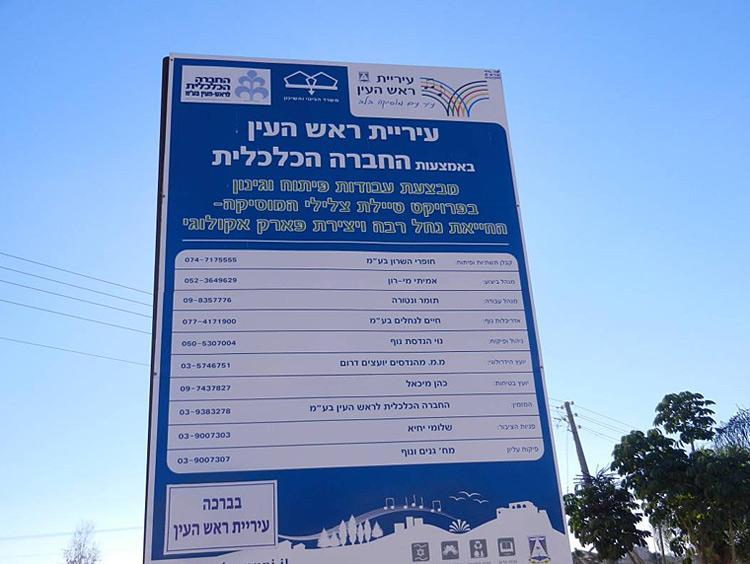
Project executors. Note the cynicism (or ignorance) in the caption: "Revitalization of Naḥal Ra'ah and the creation of an ecological park"
To enter the album (which includes additional photos), click on the thumbnails
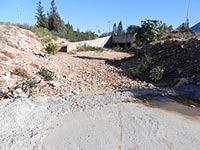
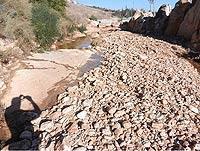
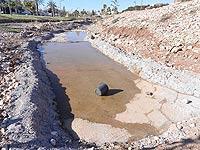
>>> To read The Head of the Administration's response