Amphibia
More than 8500 species are recognized in the class Amphibia worldwide, most of them in the family Ranidae.
Amphibians spend the early stages of their lives in an aquatic environment, while the later stages are spent in a terrestrial environment, hence the name "amphibians". Evolutionarily, these are the first animals to have left the water and begun adapting to life in a terrestrial environment (for more information - in the list of sources).
The following genera and species are known in the country:
Striped newt Ommatotriton vittatus
Common salamander Salamandra infraimmaculata
River frog Pelophylax ridibundus
Green toad Bufotes sitibundus
Cat's eye spadefoot Pelobates syriacus
Black-bellied roundfrog Latonia nigriventer
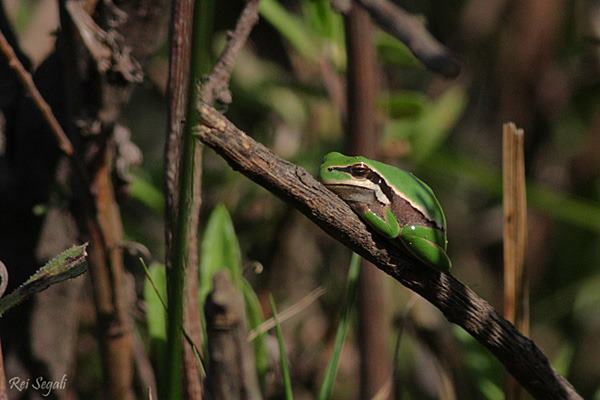
Tree frog Hyla felixarabic, Hyla savignyi, Hyla heinzsteinitzi
The common, known tree frog is Common tree frog (Hyla savignyi). Although observations of tree frogs are classified under this name, we note here that the name tree frog refers to what is mentioned in various sources as three species of frog, the other two:
Arabian tree frog Hyla felixarabic: this species was defined on the basis of genetic findings. Today, it cannot be identified in the field, and it is not known if or how it can be distinguished in observation by ordinary means from the common species. For more information:
Gvozdik V, Moravec J, Klutsch C, Kotlik P 2010 Phylogeography of the Middle Eastern tree frogs (Hyla, Hylidae, Amphibia) as inferred from nuclear and mitochondrial DNA variation, with a description of a new species
Steinitz's tree frog* Hyla heinzsteinitzi: its systematic status is unclear, and it is probably extinct in the wild: not because of climate change or pollution of water sources, but thanks to several officials in the authorities in Israel. More information about it -
Grach, C., Plesser, Y., & Werner, Y. L. (2007). A new, sibling, tree frog from Jerusalem (Amphibia: Anura: Hylidae)∗ . Journal of Natural History, 41(9–12), 709–728. https://doi.org/10.1080/00222930701261794