Butterfly life cycle
The life cycle of butterflies includes four stages: egg, larva, pupa, and adult (complete metamorphosis). Metamorphosis allows better use of the resources in nature. The larva feeds mainly on plants (host plants), while the adults feed on flower nectar (nectar plants) and sometimes on the juices of rotting fruit (there are butterflies that do not feed at all in the adult stage).
A different diet between the larva and the adult prevents competition between them and allows survival through the different seasons of the year.
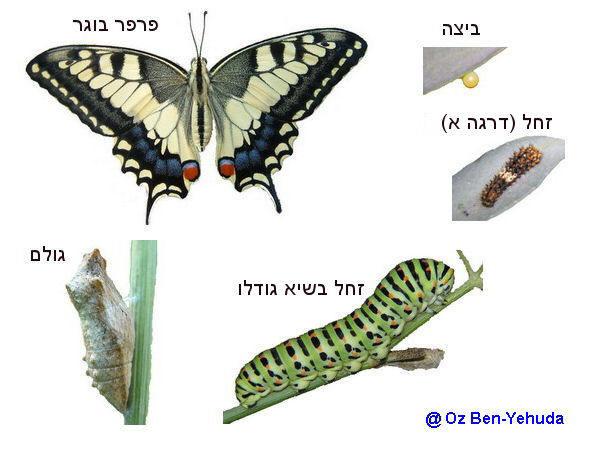
The larva, adapted to eating leaves, is very different from the adult, adapted to sucking nectar, which requires an "intermediate stage" that is the pupa.
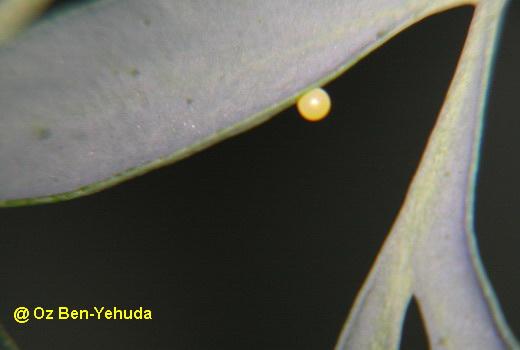
The egg contains nutrients (proteins, fat) needed for the larva's development , and a membrane made of chitin. At the top of the egg there is a depression with openings (one or more ), through which the sperm penetrates during laying. The female lays the eggs, usually on the plant on which the larva feeds. The number of eggs laid varies among species (from dozens to thousands). There are butterflies that lay their eggs in groups ((Cabbage white) and there are those that lay them singly (Beautiful swallowtail). The eggs have different shapes (from flattened to conical, smooth or with longitudinal ridges, and more) and different colors . The size of the eggs ranges from about 0.5 mm to about 2.5 mm .
The development of the egg and the time until the larva hatches vary among species (from a few days to several months). Development depends greatly on environmental conditions (rapid development at optimal temperatures: 25 to 30 degrees Celsius, desiccation and death at high temperatures; slow development at low temperatures).
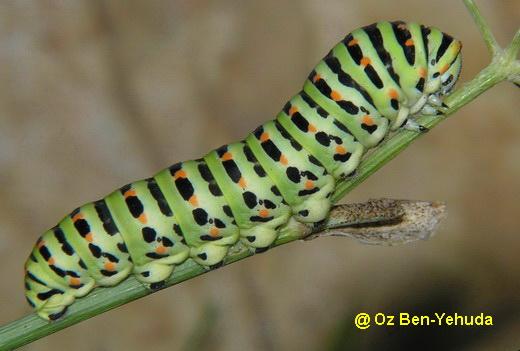
Using its jaws, the larva breaks through the eggshell. There are species in which the eggshell serves as its first meal. The larva spends most of its time eating and growing. It grows to up to 50 times its length and up to 10000 times its weight. As its body grows, the larva sheds its skin 4-5 times, and some species feed on the cast skin. There are larvae that can eat several plant species (polyphagous), and there are those that feed on only one plant species (monophagous). Some species feed on clothing, paper, wool, and feathers, and some species even prey on aphids and ant larvae. In addition to the three pairs of legs on the thorax, the butterfly larva has five pairs of false legs. These are skin protrusions that extend from the abdomen and help in walking and gripping the branch. The larval development time varies among different species (from about two weeks to about 10 months) and depends on the weather.
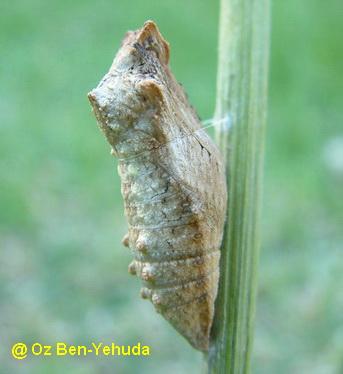
When the larva reaches its final size, it stops eating and looks for a place where it can pupate. The pupa (which in some species is inside a cocoon) is immobile, does not take in food, and within it complex physiological processes occur that break down the larval body and build the body of the adult butterfly. This stage lasts from a week to several years and depends on the weather and other factors.