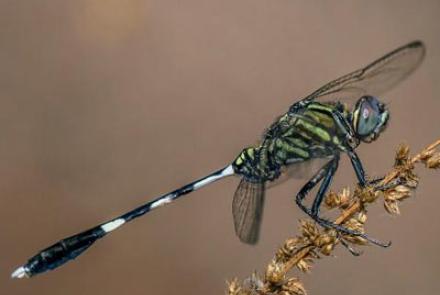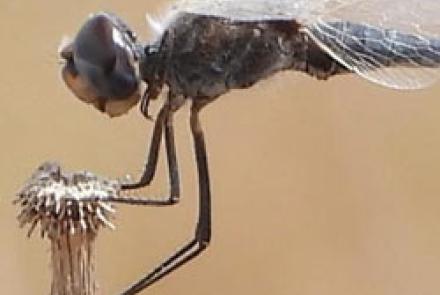

Imperial hawker Anax parthenope
English name: Lesser Emperor
Like all members of the hawker family, the Imperial hawker patrols its territory back and forth and drives out any intruder.
Size: large. Slightly smaller than the Emperor dragonfly (about 7 cm).
Habitat: Ponds or small reservoirs, and it does not shun brackish water either. The female lays her eggs on floating plants in the water, while the male is usually attached to her and makes sure she does not mate with other males.
Distribution: Almost throughout Europe and Asia, as well as North Africa.
In Israel it is common and conspicuous thanks to its size and coloration.
Season: From the end of March until the beginning of December. (According to data from Turkey)
Identification marks:
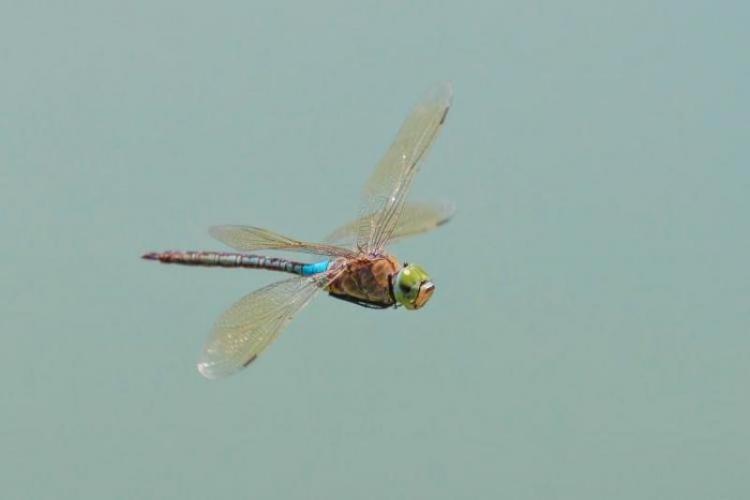
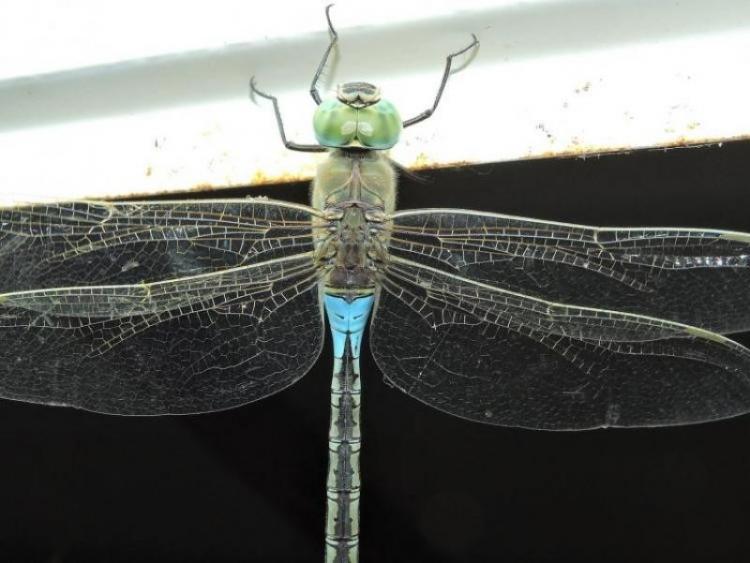
The thorax is gray-brown, and the abdomen is also gray with a black stripe לאורך its entire length (in the female) or only on segments 3-10 (in the male). Segments 2-3 of the abdomen are conspicuous light sky-blue with a prominent yellow band at the beginning. Some females have a green/blue abdomen with the black stripe, and some have no blue on the abdomen at all - not even on segments 2-3.
The costa (the leading edge of the wing) is yellow.
In many cases the wing is tinted yellow in its center.
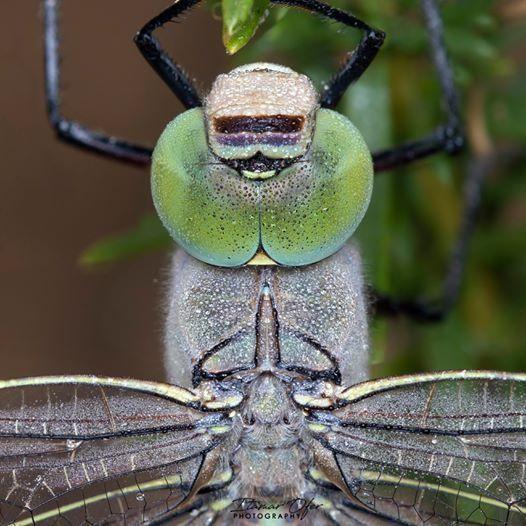
The eyes are green, and in front of the eyes on the head there is a black triangular spot.
The male has a narrow waist at segment 3 of the abdomen. The female does not have a significant narrowing of the abdomen.
Another important identifying mark among the three common hawker species is the structure of the male appendages. At the bottom of the page there is an illustrated comparison between the three species.
Similar species:
Emperor dragonfly, Migratory hawker

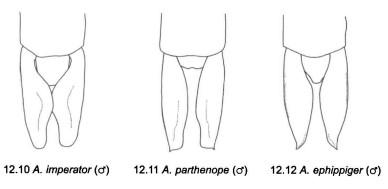
Kalkman, V.J., 2006. Key to the dragonflies of Turkey, including species known from Greece, Bulgaria, Lebanon, Syria, the Trans-Caucasus and Iran. Brachytron 10: 3 - 82