
From the Field, 04/07/2023
Anyone following the natural environment in the country is aware that we are witnessing a historical event on a geological scale: the current government is a natural disaster whose damage will not be repaired in our time. From the moment it was formed, we have passively accepted the diversion of public attention away from the natural environment. However, we must write and remind: the current clown will look less amusing when we deal with infectious diseases and childhood morbidity. Whoever floods the country with waste and disposable utensils and breaks records in the import of live cattle for slaughter is harming us directly. We expect the relevant people and institutions to address this. This can be done without harming professional work or research progress: posters, calls to action within various conferences, and more. To those who fear acting and speaking out, we remind you that loyalty to the establishment does not provide resistance against breathing polluted air or drinking filthy water.
With this optimistic note, we will mention some of the mammal observations that were recently classified in the system:
Porcupine common (Hystrix indica)
The porcupine is a mammal of the porcupine family (HYSTRICIDAE) which includes four genera and about twenty species. The scientific and English names of the species (Indian porcupine, Hystrix indica) indicate its distribution on the Asian continent. The porcupines found on the American continent, whose name (- not the scientific one) is "tree porcupines," do not belong to this family.
The porcupine is the largest rodent in our region. The weight of an adult individual is about 8 kg on average, but it may be much higher. Porcupines are found in most parts of the country, and in a wide range of habitats - including in distinctly desert areas, although there the population density is relatively low. This is a nocturnal rodent, which is rarely seen in the early evening hours: usually it is seen at later hours, and even reduces activity on full-moon nights.
During the day it usually resides in dens, natural or ones it dug itself, but it may also use structures and shelters built by humans. Porcupines show relative fidelity to home ranges and the daytime den, to which they return at the end of nocturnal activity. At several sites in the country, porcupines have adapted well to human settlements: females accompanied by young are seen within settlements. The phenomenon is known mainly in moshavim in the Shephelah and the coastal plain, and also in several settlements in the Galilee and the Golan Heights. In Jerusalem, porcupines can be seen feeding on food scraps in city parks. Porcupines may cause damage to ornamental gardens, but this can be prevented by simple means: spraying protective materials on irrigation pipes and more. The porcupine is a wild species protected by law; harming it is prohibited. Several individuals were reported in recent days from the Mount Sagi area (Eyal S).
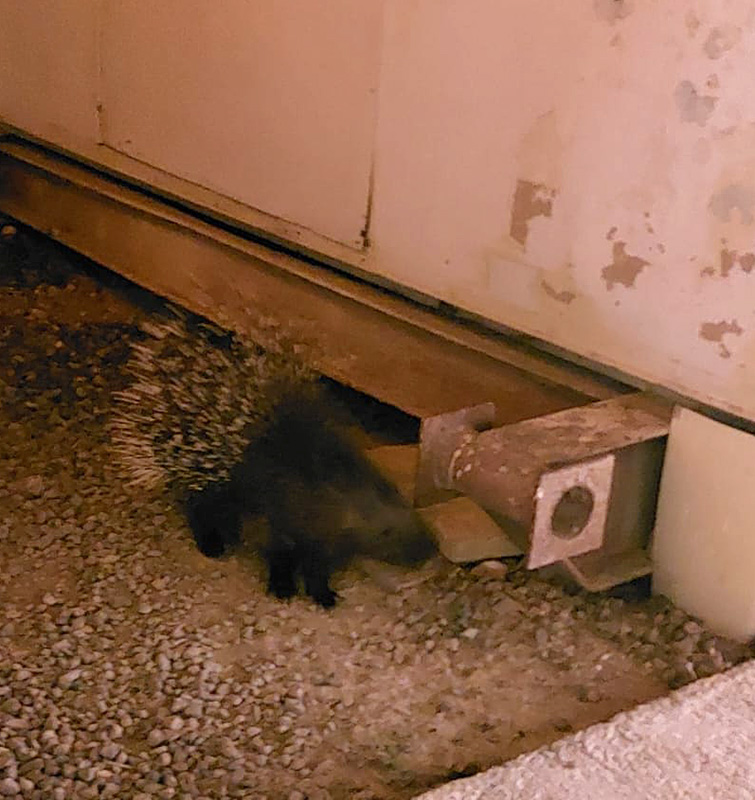
Common porcupine, Hystrix indica. Young individual in the Mount Sagi area, 01/07/2023. © EyalS
Golden jackal (Canis aureus)
The jackal is an adaptable (opportunistic) animal that succeeds in living and reproducing in inhabited areas. Compared with other carnivore species, it is relatively unafraid of humans, and in several sites in central Israel (including Yarkon Park) it can be observed up close. Although for some of us it is a nuisance and a pest, a brief literature review shows that the issue of jackal management requires reconsideration (that is - many individuals are destroyed by the authorities in a criminal manner). Due to the great variation among populations, the management method must be adapted to each area specifically. In addition, the jackals' social structure, the variation among populations, vocal communication patterns, and more, are fascinating topics for research, and many discoveries are certainly hidden in them.
Gray wolf (Canis lupus)
Wolf sightings were reported from the southern Arava and the Golan Heights, including a sighting of an adult individual observed from a moving vehicle – the wolf was moving along the road about 1 km north of Yotvata, carrying food in its mouth (Gili, 01/07/23).
Striped hyena (Hyaena hyaena)
Sightings of hyenas are recorded in the system relatively frequently, among other reasons because it finds food near human settlements and roads. Recently a report was received from the Mount Sagi area (EyalS, 27/06/23).
Israeli gazelle (Gazella gazella)
A male and two females were observed in the Elad Park area (Noam Segev).
Myotis blythii (Myotis blythii)
Myotis blythii is similar in size to the greater mouse-eared bat, and this is one of the reasons for the difficulty in relating to past information about the two species. In fact, even newer observations often remain unclassified: the distinction between species in the genus is not simple, even on the basis of recordings; though it seems that the new detectors available today will make this easier. The species is known from a few sites in northern Israel, including Mount Hermon. In the past it was much more common, as its name indicates, and is therefore mentioned in our sources as the most common of its genus.
Hedgehog (Erinaceus concolor)
The largest of the three hedgehog species found in the country, it is often seen in settlement areas.